Up

Share your Content with the FDT Community

You want to join the FDT community? That’s easy, simply send us your news and be part of the FDT community page

[contact-form-7 id=”6383″ title=”Take Part”]

Linux builds have been tested on Ubuntu but should run on other distributions too.

With the download of FDT you accept our EULA

Featured

FDT Views/Editors follow Dark Theme

With this release FDT can easily switched to dark theme:Simply select the Dark theme and apply. The Dark theme is available since Eclipse 4.4 (Luna). Older versions of Eclipse (and FDT) does not support color themes of this form. The FDT views and editors will switch to their default dark color set: In case you […]

by FDT Team

FDT Newsletter

Subscribe to our FDT mailing list and get the latest news and vouchers! * indicates required Email Address * First Name Last Name

by FDT Team

FDT Milestone 10 – 10 years anniversary

We‘re happy to announce FDT Milestone 10! It‘s been 10 years since our first FDT release and a lot happened since last years Milestone 9. We went on to improve FDT and your IDE experience. Here is a list with our new key features: Ant Project Generator Dump launch configuration Library Project Template ActionScript refactorings […]

by FDT Team

Library Project Template

This new FDT release contains features to support a more fluent development of SWC libraries. The primary starting point to develop a library is the new Library Project Template for AIR or Web: This template creates an empty library project containing two source folders: All compilation units to include into the library should be placed […]

by FDT Team

Release 9.9 – Project groups

With this release the FDT Explorer can present projects in groups: Each Project Group is a set of workspace projects (i.e.: Working Set). Each project can be a member of one group and can not be shared among groups. Project Groups are logical structures shown inside FDT Explorer. Neither they represent nor they change the […]

by FDT Team

FDT 4.0 M2 "Making Things Easier" released

May 10, 2010 by Michael Plank
After the successful release of FDT 4.0 M1 including a state of the art Profiler, the team is proud to announce the release of FDT 4 Milestone 2. When we asked the community which new features they want to see in the next major version of FDT the majority answerd with: „Make things easier“. All features and improvements of Milestone 2 are dedicated to this request.
The main new features are a completely reworked Flex SDK management, and a brand new project management including project types and project templates.
After the successful release of FDT 4.0 M1 including a state of the art Profiler, the team is proud to announce the release of FDT 4 Milestone 2. When we asked the community which new features they want to see in the next major version of FDT the majority answerd with: „Make Things Easier“. All features and improvements of Milestone 2 are dedicated to this request.

The main new features are a completely reworked Flex SDK management and a brand new project management including project types and project templates.

New Flex SDK management

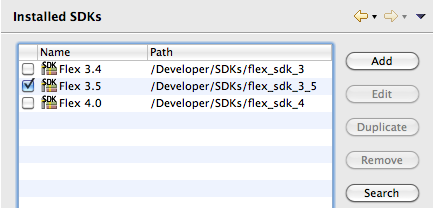
The core library system of FDT 3 has been completely removed and replaced by an easy to use SDK management. The confusing core library variables like Flex_SDK_0_Pure or Flex_SDK_0_for_FP10 are finally history. You will not find them any more in M2.

Managing your SDKs like adding, removing, duplicating or editing Flex SDKs of any version is amazingly easy now.

Adding an additional Flex SDK is now as simple as clicking the Add button and selecting a folder. FDT scans the SDK folder and displays detailed information on version number and included SWC libraries.

Nice right? But we made it even easier. Add multiple Flex SDKs with just one click by using the Search functionality! FDT will search for available SDKs on your hard disc and will automatically add them.
New project management

Milestone 2 introduces project templates as well as project types. Creating a new Flash project will now open up the brand new project creation wizard.
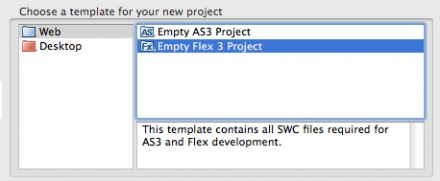

Just select a template from any category and FDT will create a new project based on the selected template. M2 ships with some predefined templates but you can create your own templates as well. You can incorporate source folders, an icon, files and folders, packages with classes and SWCs that should automatically be added to the classpath to your template. Check out this tutorial on how to create your own templates.

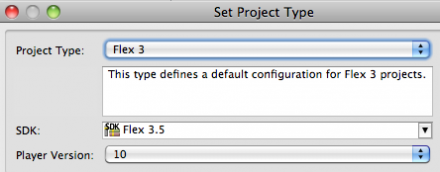
FDT 4 M2 also brings the concept of project types into use e.g. „Flex 3 Project“ or „AS3 AIR Project“. A project type defines the basic setup of a project like linked Flex SDK SWCs, available viewers and compiler arguments. Same as templates, project types are defined in XML format and can be edited or added by the user. The project type can be changed at all time for example from a Flex 3 project to a Flex 3 AIR project.
Project settings

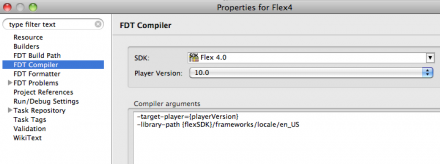
Compiler settings can now be edited in the project properties.


Launch configurations now use the settings from the project properties by default. You can still override these settings in the launch config.

The Flex SDK and target Flash Player version can easily be changed.

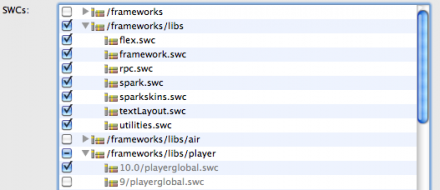
In the project build path settings you will now find a new tab called „SDK library“. Here you can add and remove Flex SDK SWCs by just selecting/deselecting them.

User wide preferences

The new settings for installed Flex SDKs, project templates and project types are now stored in the user directory. This implicates that these configurations are available across multiple workspaces!

We strongly believe that putting more and more settings to the user folder is the right way to go. It would put an end to setting up all FDT preferences whenever you create a new workspace. Feedback to this decision is highly appreciated!

Migration from FDT 3 to FDT 4

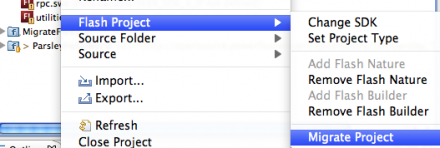
FDT 4 M2 uses new project setting files (invisible .files). Therefore an old project created with FDT 3 needs to be migrated to a FDT 4 project. Justright click the old project and select Flash Project > Migrate Project. This feature adds the new project files based on the old settings. After migrating to a FDT 4 project you can still work on it in FDT 3.
Links

Happy coding,
Michael

JIRA for Bug Reports and Feature Requests

September 22, 2008 by Michael Plank

We now use JIRA for bug tracking and feature requests. Please post your FDT bug reports  and feature requests at bugs.powerflasher.com.

In order to add an issue to JIRA, you have to register an account first. Please don’t use the FDT Forum anymore to report bugs.

JIRA is also used for the SOS Project.

Michael Plank

Optimize your workflow with the new Features of FDT 3.1

September 8, 2008 by Michael Plank

We have just released a new version of FDT (FDT 3.1.0 build 1011) which includes many new features and numerous bugfixes. You can find a list of all additional features and bugfixes here. In this article I’m going to show you how to improve and optimize your ActionScript development workflow by using the new features.

Installation

We now provide FDT installers for Windows and Max OS X. Simply download the appropriate installer and follow the installation instructions.
The FDT 3.1 installation includes Eclipse 3.3 (Europe) and the most important plug-ins for ActionScript development like Subversion (Subversive) and a XML Editor (WST).

If you already have installed Eclipse (3.3 or 3.4), you can use the “Find and Install” mechanism (Help > Software Updates > Find and Install) to integrate FDT in your existing Eclipse copy. Use the following URL for your new remote site: http://fdt.powerflasher.com/update

The Flex SDK 3.1 is included in both installation types and all core library settings are now configured automatically. This means that you can compile, debug and launch your ActionScript 3 projects immediately after the installation process.

Installing and setting up FDT 3.1 is now way faster than setting up previous versions of FDT.

Project Structure

It is very important to use a clear and continuous folder structure for your ActionScript projects. FDT helps you organize this structure.

If you create a new Flash Project it’s now possible to select “Create separate folders for sources and binaries” in the wizard.

Create Separate Folders

You can configure those folders by pressing “Configure defaults…” or by opening the FDT Build Path preferences window.

In the following example I will use dev/src as my source folder and dev/deploy as my output folder.

Build Path Preferences

FDT will automatically put all SWF and SWC files into the deploy folder.

AIR Support

Developing AIR applications with FDT 3.1 is also very easy now. Simply create a launcher for viewing and debugging your application and one launcher to release it as .air file.

To create an AIR debug launch configuration select your Document Class in the Flash Explorer and then open the Run Dialog (Run > Open Run Dialog…). Double click “FDT AS3 Application “ to create a new launch configuration. After that select the “Start” tab and choose “AIR Debug Launcher” as viewer.

AIR Debug Launcher

Press the “Run“ button to compile and launch your AIR application. FDT automatically generates a default application XML file into your output folder.

To release and package your AIR application open the Run Dialog and double click “FDT AIR Application Release” and configure the settings on the right-hand side.

Michael Plank

FDT 3.1 RELEASED!!

September 2, 2008 by Carlo Matic

Hi folks,

we have fixed the few bugs, tested it a thousand times and now we have done it: we released the new 3.1 version of FDT!!!!

You can download the new installer now from our website. There are really some nice new features. Also we fixed a lot of things you reported, so thank you for that!! Here are the additional features of the new version:

  • Shipped Flex SDK 3.1
  • Default Source Folder is created with a new project
  • You can now define a “Standard Output Folder” per project, where generated SWF files from the launcher are generated by default
  • FDT Intro Contribution
  • FDT Cheat Sheets
  • AIR Debug Launcher as SWF Viewer
  • AIR Release Launcher
  • SWC Outline view
  • QuickTrace (Ctrl+0/Command+0)
  • Launchers can now be started by selecting an editor or a file and pressing “Run” or “Debug”
  • New Launch Shortcut for AS3 Libraries (Run Project as AS3 Library)
  • User Documentation is updated for FDT 3.1
  • Better sorting of the autocompletion proposals
  • Better autocompletion behaviour after “new”, “extends” and “implements”

Here you can find a complete buglist that we fixed in this version: buglist

Check it out and tell us what you think!!

Cheers,

Frank

Get FDT5