Up

Share your Content with the FDT Community

You want to join the FDT community? That’s easy, simply send us your news and be part of the FDT community page

[contact-form-7 id=”6383″ title=”Take Part”]

Linux builds have been tested on Ubuntu but should run on other distributions too.

With the download of FDT you accept our EULA

Featured

FDT Views/Editors follow Dark Theme

With this release FDT can easily switched to dark theme:Simply select the Dark theme and apply. The Dark theme is available since Eclipse 4.4 (Luna). Older versions of Eclipse (and FDT) does not support color themes of this form. The FDT views and editors will switch to their default dark color set: In case you […]

by FDT Team

FDT Newsletter

Subscribe to our FDT mailing list and get the latest news and vouchers! * indicates required Email Address * First Name Last Name

by FDT Team

FDT Milestone 10 – 10 years anniversary

We‘re happy to announce FDT Milestone 10! It‘s been 10 years since our first FDT release and a lot happened since last years Milestone 9. We went on to improve FDT and your IDE experience. Here is a list with our new key features: Ant Project Generator Dump launch configuration Library Project Template ActionScript refactorings […]

by FDT Team

Library Project Template

This new FDT release contains features to support a more fluent development of SWC libraries. The primary starting point to develop a library is the new Library Project Template for AIR or Web: This template creates an empty library project containing two source folders: All compilation units to include into the library should be placed […]

by FDT Team

Release 9.9 – Project groups

With this release the FDT Explorer can present projects in groups: Each Project Group is a set of workspace projects (i.e.: Working Set). Each project can be a member of one group and can not be shared among groups. Project Groups are logical structures shown inside FDT Explorer. Neither they represent nor they change the […]

by FDT Team

User Story: GameDuell and the Benefits of Using FDT 5 MAX

January 19, 2012 by Carlo Matic

The guys from GameDuell wrote us a really nice user story that we don’t want to hold back. GameDuell successfully develops Flash games with FDT. Thank you guys for sharing your story!

“The use of the FDT refactoring- and advanced code-navigation tools allows maintaining our source code across projects that are being written by many different developers. FDT gives us the power we need in order to be agile and have clean code at the same time.”
Daniel Döller, Lead Flash Developer

The Challenge:

GameDuell has developed 60 flash-based games in our own studios and embedded them in a unique tournament platform that enhances social gameplay. GameDuell is available on its own brand website as well as on partner sites, social networks, and the iPhone. GameDuell produces fast, productive games and for the developing we need simple and powerful tools.

The Solution:

Using a debugger is an immense improvement of the workflow. The ability to remote-debug is the biggest advantage for us because we are able to debug the application inside the real online scenario and not just locally in a “fake” environment, which can never reflect the live-version completely. Due to the amount of Flash developers it was always a risky task to change something inside the existing libraries. Now we have refactoring features and can finally preview all changes which are being made by renaming classes or properties. Therefore, the process of applying changes is much smoother and more predictable than before.

The History:

GameDuell was founded in 2003 with the vision to combine social games with innovative transaction models. Our passion for high-quality games and a thrilling user experience has made GameDuell one of the best monetizing, as well as one of the largest, casual games communities in the world. Our products are available in 7 languages and are played by more than 12 million people every month.
Our network of more than 200 distribution partners includes the most prominent Internet portals and game sites in the world. The company is driven by a team of over 170 game-enthusiasts and has offices in Berlin and San Francisco.

Conclusion:

For us working and developing with FDT is productive and fun!

FDT 5 coming soon!

August 30, 2011 by Carlo Matic

We’re proud to officially announce FDT5 in October. A microsite will guide you to all details and news about it in the next weeks.

Just like the Internet evolves with new technologies, FDT continuously takes technological leaps. We are currently working hard on FDT 5 to bring you a whole new level of flexibility, power and comfort. New technologies, new editions, new features, new prices, and an awesome surprise will blow your mind. FDT 5 will be launched in October and we want to celebrate the news in four steps. Little by little we will show you more and more about the new version of FDT on our new HTML5 promotion site (created in FDT 5):

http://FDT5.com

With FDT 5 we want to evolve the future as the most flexible development tool for interactive coders and game developers. Flash and Flex will still be the #1 technologies, but it will also focus on HTML5 / JavaScript / WebGL, PHP with Haxe and mobile and game development.

Share the news on Twitter or Facebook and win an FDT5 Max license:
@FDT5 release is announced for October and will focus additionally to AS3 & MXML on HTML5, JS, WebGL, PHP and more via @FDThaXe

Get thrilled for the new FDT and stay tuned!

FlashONGames First Meeting!

September 10, 2010 by Carlo Matic


Bruno Fonzi, Powerflasher based in San Francisco, CAhas started a new user group FlashONGames together with Alec McEachran, Senior Software Engineer @ Gaia Interactive and Allen Ellison Solutions Architect @ Adobe

You might be wonder why Powerflasher is organizing these gaming events… well the Powerflasher agency has built hundreds of games for our customers and most of all we like to play !

About FlashONGames

This is a flash gaming group located and hosted in San Francisco, focused and aim to involve audience and speakers at the national level. All sessions will be broadcasted live and recorded.

FlashOnGames covers all aspects of a flash gaming development phases, design best practices and technical challenges. Covering the entire gaming lifecycle, from the initial concept game idea, the designer and developer workflows, testing aspects and customers feedback and delivery.

It explores the gaming ecosystem, social platforms, frameworks, distribution, marketplace for the multiscreen gaming.

Our first FlashONGames meeting

We had an amazing turn out!  We also had fun and I hope you have learned something new too!

If you could not make it, no worries!

The video recording and presentation can be found here

Stay tuned for the next event!

Follow @FlashONGames on Twitter

In the meantime … If you have an idea or any feedback, let us know , Ask the team anything or Submit an article to publish on the FlashONGames website!

Looking forward to hearing from you!

Bruno Fonzi

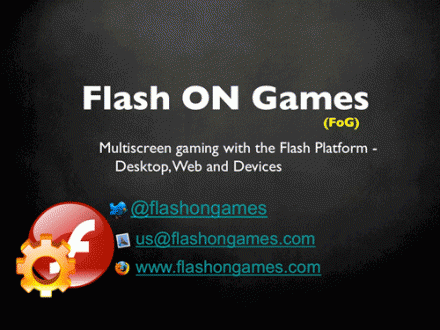
Flash On Games (FoG)

August 24, 2010 by Carlo Matic

Multiscreen gaming with the Flash Platform – Desktop, Web and Devices

As you might know by now, at Powerflasher, we like to play! Plus, we think Flash and Gaming are a good match !

We are very excited to host together with Adobe our first Flash On Games (FoG) meeting, scheduled the 7th of Sept 2010

This is a flash gaming group located and hosted in San Francisco, focused and aim to involve audience and speakers at the national level. All sessions will be broadcasted live and recorded. A link to the webcast will be sent in a follow up email once registered. I hope you can join us.

Register here flashongames.eventbrite.com

In our first meeting we’ll have the following two session:

1. Flash Sizing Zen: Android Devices

Getting Android to Respect Your Intent

by Allen Ellison Solutions Architect @ Adobe

When you bring Flash games and content to the multi-screen web using Flash Player 10.1, it can be a challenge to get your content to displayed consistently across devices as you intended; in terms of size, orientation, alignment, interactivity and full-screen behavior. This becomes even more complex when you start taking web tablets into consideration.

There are a number of obstacles to creating a consistent and usable experience including mobile content transcoders, mobile devices that behave in certain ways to make a web experience really intended for desktop systems accessible to mobile users, an inconsistent use of HTML tags and meta-tags across device families, and user-configurable browser or device settings.

So, in order to create an experience that scales gracefully between desktop browsers and mobile browsers, this session will walk you through the steps necessary to eliminate the various potential points of variation.

2. Particle Systems 101

by Alec McEachran, Senior Software Engineer @ Gaia Interactive

If you have ever wanted fire, waterfalls, clouds, snow or myriad other effects in your Flash games, then you have needed to create particle systems. There are loads of particle effect systems out there that might suit your needs, but if you want your games to remain fast, you have to roll your own.

In pure AS3, this session will look at one way to build a fast particle system from the ground up, and survey some of the techniques for moulding your particles into the effects you’re looking to achieve.

About Flash On Games (FoG)

FlashOnGames covers all aspects of a flash gaming development phases, design best practices and technical challenges. Covering the entire gaming lifecycle, from the initial concept game idea, the designer and developer workflows, testing aspects and customers feedback and delivery.

It explores the gaming ecosystem, social platforms, frameworks, distribution, marketplace for the multiscreen gaming.

Follow us on Twitter @FlashOnGames or visit our website flashongames.com


Cheers,

Bruno Fonzi

Get FDT5